November 11, 2025
Back to Blogs
The Silent Crisis in Healthcare Operations — And How AI Automation Is Solving It
AI Automation Healthcare
Healthcare institutions face growing operational challenges. AI automation is helping hospitals streamline workflows, improve diagnostics, and enhance patient care through intelligent systems.
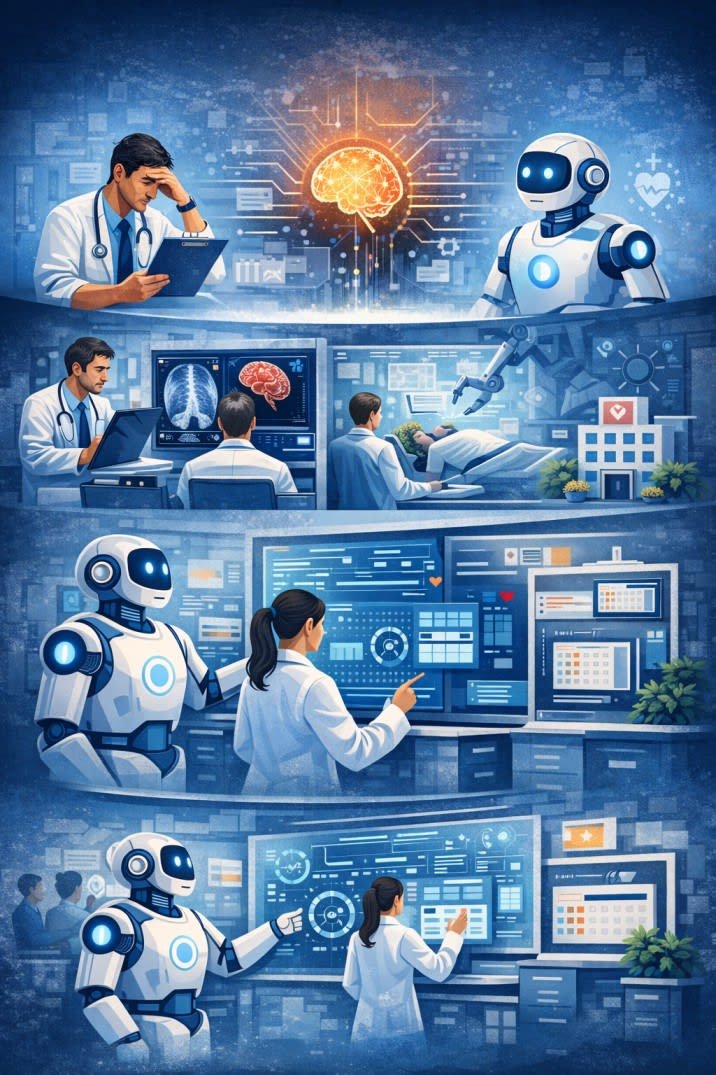
Healthcare is built to save lives. But behind every hospital, clinic, and diagnostic centre lies a system struggling under operational pressure. Doctors are overwhelmed with documentation. Administrative teams are buried in manual workflows.
Patient demand continues to rise. Operational costs keep increasing. While medical science has advanced rapidly, healthcare operations in many institutions are still running on outdated systems and manual processes.
This gap between medical innovation and operational efficiency is where artificial intelligence is beginning to reshape the future of healthcare.
Healthcare’s Biggest Problem Isn’t Technology — It’s Time
In most hospitals today, clinicians spend a surprising amount of their time not treating patients but managing paperwork. Studies across healthcare systems reveal that doctors can spend 30–40% of their time on administrative work, such as:
• Medical documentation
• Data entry into patient records
• Reviewing fragmented medical information
• Compliance reporting
• Managing patient scheduling and follow-ups
This creates two serious consequences:
1. Reduced time for patient care
2. Increased burnout among healthcare professionals
AI automation is emerging as the solution to this silent crisis.
AI Automation: The New Operating System for Healthcare
Artificial Intelligence in healthcare is not about robots replacing doctors. Instead, it acts as an intelligent operational layer that supports medical professionals by automating repetitive tasks, analysing complex medical data, and improving decision-making. When implemented correctly, AI becomes the digital backbone of modern healthcare institutions. It enables hospitals to operate faster, smarter, and more efficiently without increasing staff workload.
Where AI Automation Is Creating the Biggest Impact
1. Eliminating the Documentation Burden
One of the most transformative uses of AI in healthcare is clinical documentation automation.
AI systems can now:
• Convert doctor–patient conversations into structured clinical notes
• Automatically generate discharge summaries
• Extract relevant insights from medical records
• Organise patient histories in real time
Instead of spending hours writing reports, doctors can focus on patient interaction while AI handles the documentation. This alone can reclaim several hours per week for each clinician.
2. Smarter Diagnostics Through Data Intelligence
Medical diagnosis increasingly relies on interpreting vast amounts of data — from imaging scans to lab reports and patient histories. AI systems can analyze this data in seconds and assist doctors in identifying patterns that might otherwise go unnoticed.
AI-assisted diagnostics are already helping with:
• Early cancer detection
• Radiology image analysis
• Cardiovascular risk assessment
• Pathology slide interpretation
• Neurological disorder detection
Rather than replacing doctors, AI acts as a decision-support system, helping clinicians make faster and more informed medical judgments.
3. Predicting Health Risks Before They Become Emergencies
Healthcare has traditionally been reactive—treating illnesses after symptoms appear. AI enables a shift toward predictive healthcare, where potential health risks can be identified before they escalate.
By analyzing historical patient data, AI models can predict:
• Likelihood of hospital readmission
• Early signs of patient deterioration in ICU
• Chronic disease progression
• Infection risks within healthcare facilities
This predictive capability allows healthcare providers to intervene earlier, improving outcomes and reducing treatment costs.
4. Transforming Hospital Operations
Hospitals are among the most complex operational environments in any industry. They must coordinate doctors, nurses, patients, operating rooms, equipment, medications, and compliance requirements — all simultaneously.
AI automation can optimize these operations by managing:
• Doctor and staff scheduling
• Patient bed allocation
• Operating room utilization
• Emergency department triaging
• Medical inventory and supply chains
With AI-driven operational intelligence, hospitals can significantly reduce waiting times and improve patient throughput.
5. Redefining the Patient Experience
Modern patients expect healthcare experiences that are as seamless as other digital services. AI-powered systems can automate many aspects of patient interaction, including:
• Appointment scheduling and reminders
• Virtual health assistants for patient queries
• Post-treatment follow-ups
• Medication reminders
• Remote patient monitoring
These capabilities improve patient engagement while reducing the workload on hospital staff.
The Real Value of AI in Healthcare
The true power of AI automation lies not only in efficiency but also in system-wide transformation. Healthcare organisations adopting AI are seeing measurable benefits such as the following:
• Reduced administrative burden for clinicians
• Faster diagnostic turnaround times
• Improved clinical decision-making
• Better resource utilisation across hospital departments
• Enhanced patient satisfaction and engagement
In essence, AI allows healthcare systems to scale their capabilities without a proportional increase in costs or workload.
The Future Hospital Will Run on Intelligence
Healthcare institutions around the world are entering a new era — one where human expertise and artificial intelligence work together. The hospitals of the future will operate with the following:
• AI-assisted diagnostics
• Automated clinical documentation
• Predictive patient monitoring systems
• Intelligent hospital management platforms
• AI-powered operational analytics
Organisations that adopt AI today will not just improve efficiency — they will redefine how healthcare is delivered.
Conclusion
Healthcare will always depend on the expertise, empathy, and dedication of medical professionals. But the systems that support them must evolve. AI automation offers healthcare institutions a powerful opportunity to reduce operational burden, improve patient outcomes, and build more resilient healthcare systems.
The goal is not to replace human care. It is to give healthcare professionals the time and intelligence they need to deliver it better.