August 12, 2026
Back to Blogs
AI-Powered Bag Counting for Warehouses: A Complete Guide
computer vision warehouse automation
Manual bag counting doesn’t scale — it’s slow, error-prone, and impossible to audit. Here’s how computer vision automates it.
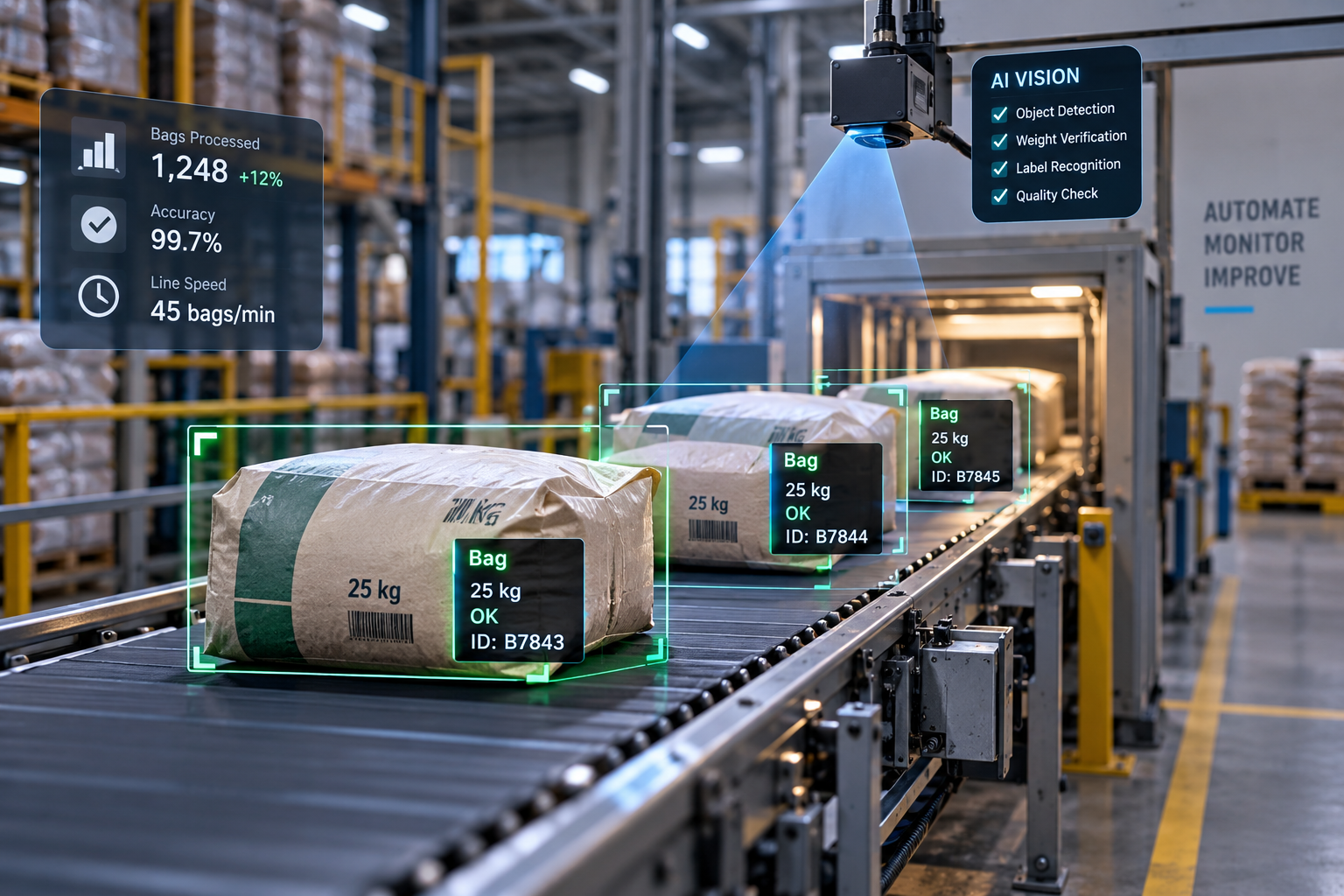
If you’ve ever wondered how modern warehouses keep an accurate tally of sacks and cartons without a person manually counting every item, the answer is computer vision — camera-based AI systems that perform bag counting in a warehouse automatically, in real time, and with far greater accuracy than manual methods.
Manual counting has always been one of those tasks that seems simple until you actually try to do it at scale. A warehouse worker tallying sacks of cement as they’re loaded onto a truck is a job that’s repetitive, error-prone, and surprisingly expensive when you add up the labour hours and the cost of mistakes downstream.
Computer vision is quietly replacing this kind of counting — not by making it flashier, but by making it faster, more accurate, and available as a continuous data stream instead of a one-time manual check.
Why Manual Bag Counting Fails at Scale
Before getting into how the technology works, it’s worth being clear about why manual counting breaks down at scale:
- Fatigue-driven errors: A person counting the same repetitive object hundreds of times a day will eventually lose count, especially in high-throughput environments like grain mills, cement plants, or fertiliser warehouses.
- No audit trail: A verbal or handwritten count is hard to verify after the fact. If there’s a dispute about how many bags left a warehouse, there’s often no record beyond someone’s word.
- Speed mismatch: Loading and unloading operations move fast. A counting process that requires a human to stop and tally slows down the entire logistics chain.
- Inconsistent shift-to-shift accuracy: Different workers count with different levels of diligence, making it hard to trust the numbers as a reliable operational baseline.
Computer vision addresses each of these by turning counting into an automated, camera-driven process that runs continuously and produces a verifiable digital record.
How Bag Counting Works in a Warehouse Using Computer Vision
At its core, bag counting uses object detection models trained to recognize bags — jute sacks, polypropylene sacks, or cartons — as they move past a fixed camera, typically positioned above a conveyor belt, a loading dock, or a truck loading bay.
The typical pipeline looks like this:
- Detection: A model (commonly a YOLO-family architecture, given its speed and accuracy trade-off) identifies each bag as a bounding box in every video frame.
- Tracking: Because a bag appears in many consecutive frames, a tracking algorithm (like SORT or DeepSORT) assigns each detected bag a unique ID so it isn’t counted twice.
- Line-crossing logic: A virtual counting line is drawn across the frame — usually at the edge of a conveyor or the mouth of a truck — and the count increments only when a tracked bag’s centroid crosses that line.
- Logging and dashboarding: Every count is timestamped and pushed to a dashboard or database, giving operations teams real-time visibility into throughput, shift-wise performance, and discrepancies against expected inventory.
Common Challenges in Bag Counting Systems
- Occlusion: Bags stacked or overlapping on a conveyor can confuse a naive detector. This is usually solved with better training data and tracking logic that can “remember” a bag briefly hidden behind another.
- Lighting variation: Warehouses often have inconsistent lighting — bright near loading bay doors, dim in the interior. Models need to be trained on footage that reflects this variability or paired with cameras that handle exposure well.
- Motion blur: Fast-moving conveyor belts can blur bag edges. Frame rate and shutter speed on the camera hardware matter as much as the model itself.
- Bag deformation: Unlike rigid boxes, sacks change shape depending on how full they are, which means detection models need training data covering a range of bag fill levels and orientations.
Done well, this kind of system routinely achieves counting accuracy in the high 90s percentile range — well beyond what a fatigued human counter can sustain over an 8-hour shift.
Why Bag Counting Matters Beyond the Number Itself
The real value of a bag counting system isn’t the count itself — it’s what the count enables:
- Inventory reconciliation: Warehouses can compare camera-based counts against ERP records in real time, catching discrepancies (theft, miscounts, damaged goods) as they happen rather than during a monthly audit.
- Throughput analytics: A continuous data stream can be mined for bottleneck analysis — which loading bay is slowest, which shift underperforms, and where delays are creeping in.
- Reduced manual exposure: Fewer people need to be physically present at high-traffic loading zones, which is a meaningful safety and efficiency improvement.
The Bigger Picture
Bag counting is one small but telling example of a broader shift happening across warehouse operations: the move from periodic, manual checks to continuous, camera-driven data. The technology has matured to the point where “put a camera on it and count automatically” is now a viable, cost-effective solution for almost any repetitive visual counting task on a warehouse floor.
Ready to Automate Bag Counting in Your Warehouse?
If manual counting is costing you time, accuracy, or visibility into your loading operations, a computer vision–based counting system can be deployed on your existing cameras or a simple camera setup—with real-time dashboards showing counts, discrepancies, and throughput as they happen.
Get in touch to discuss a bag-counting solution for your warehouse.
📧 info@ascentiqai.com | 📞 +91 99219 61947