September 5, 2026
Back to Blogs
Counting and Identifying Every Wagon: How AI Cameras Automate Railway Freight Tracking
ID reading OCR wagon counting
No more clipboards trackside. Here’s how AI cameras count freight wagons and read their ID numbers automatically, in real time.
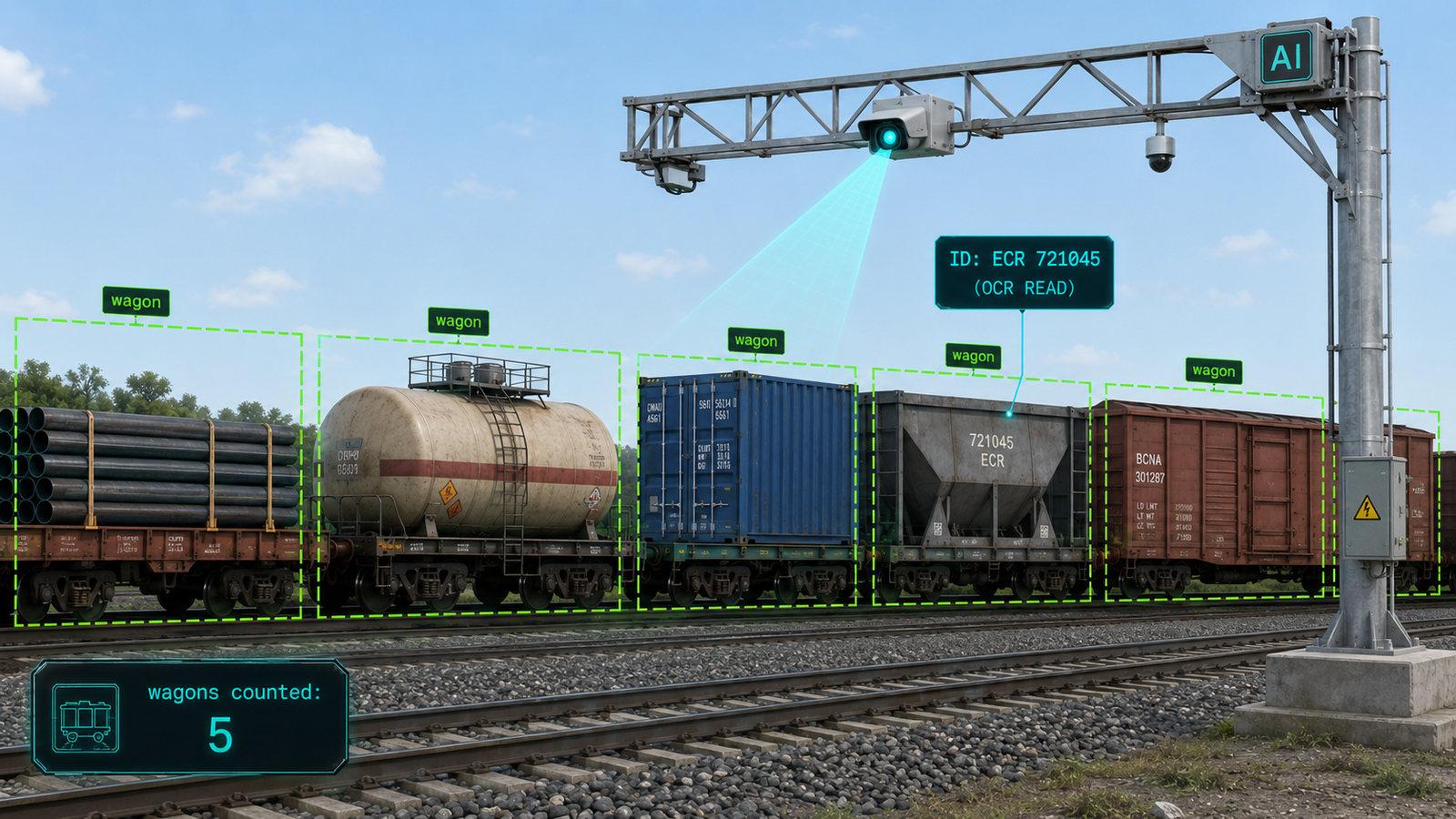
Every freight train that pulls into a yard carries two questions that used to require a person on foot to answer: how many wagons are on it, and which specific wagons are they? For decades, the answer came from a staffer walking the length of the train with a clipboard, squinting at painted numbers in the heat, the rain, or the dark.
Cameras are now taking over that job. Wagon counting and wagon ID reading — both powered by computer vision — let a trackside system automatically count every wagon on a passing train and read its identification number, without anyone needing to be near the track at all.
This guide breaks down how both pieces actually work: the detection-and-tracking pipeline behind wagon counting, the OCR system behind ID reading, and the real engineering problems — weather, speed, faded paint — that make trackside vision harder than it looks.
The Cost of Counting on Foot
Before cameras took over, wagon counting was a manual, trackside job — and it came with three built-in problems:
- Someone has to be near a live track. Walking alongside a moving or recently arrived train is inherently riskier than reviewing a video feed from a control room.
- There’s no record once the moment passes. A handwritten tally is hard to verify later — if a dispute comes up about which wagons were on a train, there’s often nothing to check it against beyond someone’s memory.
- It doesn’t scale. A yard handling dozens of trains a day can’t rely on a person keeping pace with rail traffic without becoming the bottleneck in the whole operation.
Cameras solve all three at once — not by working harder, but by turning a one-time physical check into a continuous, automatic, and permanently logged process.
Two Systems, One Camera Feed
It helps to think of trackside automation as two separate jobs running on the same video feed:
- Counting — figuring out how many wagons passed, using object detection and tracking.
- Identification — figuring out which wagons passed, using OCR to read the painted ID code on each one.
They’re built differently, solve different problems, and fail in different ways — so it’s worth walking through each on its own before looking at where they come together.
Counting: Detection, Tracking, and the Line-Crossing Trigger
A trackside camera — usually mounted on a gantry or pole for a clear side profile of the train — feeds video into a detection model that identifies each wagon as it enters the frame. Because trains move at meaningful speed even through counting zones, this step needs either a high frame rate or a global-shutter sensor; a cheaper rolling-shutter camera will skew a fast-moving wagon’s shape enough to throw off both detection and counting.
Once a wagon is detected, a tracking algorithm follows it across frames and assigns it a single ID — this is what stops one wagon from being counted twice as it moves through the field of view. The system also typically classifies wagon type (flatbed, tanker, container, hopper) and logs direction and speed, both useful for yard scheduling.
The trickiest part of this step isn’t the tracking itself — it’s deciding where one wagon ends and the next begins. For most wagons, the coupler (the connecting hardware between cars) is a clean, consistent visual reference point. But articulated wagon sets and double-stack container cars don’t always have that clean break, which means the detection model has to be trained specifically on coupler geometry rather than just wagon silhouettes.
Identification: Reading the Painted Code with OCR
Every freight wagon carries a stencilled or painted ID code — usually a wagon type code, a unique serial number, and sometimes an owning-railway code. A separate OCR (Optical Character Recognition) model reads this code directly off the wagon body as it passes, running in parallel with the counting pipeline rather than as part of it.
This is what turns “42 wagons passed” into “these specific 42 wagons passed” — and that distinction has real operational weight. It’s what lets a wagon be matched automatically to a loading manifest, a maintenance schedule, or a specific freight journey for billing purposes.
OCR on a moving wagon is a genuinely harder visual problem than counting the wagon itself. Individual characters are small, and years of weather exposure fade paint, chip it, or cover it in dirt and rust — all of which reduce the contrast an OCR model depends on. Code placement and font also aren’t standardized across operators or wagon ages, so the model needs training data covering a wide range of real-world wear, not a single clean template. Because misreads carry financial consequences, production systems typically pair every OCR read with a confidence score, automatically flagging low-confidence reads for manual review rather than guessing silently.
Where the Two Systems Add Up
Counting and identification are useful on their own, but the real value shows up when they’re combined and logged together:
- Billing and compliance accuracy — freight billing is often tied to specific wagons on specific journeys, so a count linked to a verified ID is a financial control, not just an operational one.
- Wagon-level traceability — if cameras with ID readings sit at multiple points (yard entry, loading area, exit), a single wagon’s movement through a facility can be reconstructed automatically.
- Throughput and bottleneck analysis — a continuous count-and-ID data stream can be mined to see which routes see the most wagon-type variance or where dwell times are quietly creeping up.
- Less time spent trackside — fewer people need to be physically present near live tracks, which is a straightforward safety win on top of everything else.
Where This Is Headed
The direction this technology is moving is toward fewer isolated checkpoints and more continuous coverage — cameras at every meaningful point in a yard, each one both counting and identifying, feeding into a single system that can answer questions like “Where is wagon X right now?” or “How long did this train’s wagons sit before loading?” without anyone having to go check by hand. That’s the real shift: not just replacing a clipboard, but making the entire wagon lifecycle queryable.
Ready to Automate Wagon Counting and ID Reading?
If manual wagon tallies are slowing down your yard operations or creating billing disputes, a computer vision–based counting and ID reading system can be deployed trackside—with real-time dashboards showing wagon counts, IDs, and dwell times as trains pass.
Get in touch to discuss a wagon counting and ID reading solution for your railway operations.
📧 info@ascentiqai.com | 📞 +91 99219 61947